
✨ This article was AI edited. Editorial responsibility: DemocracyLawBlog.com.
Produced with AI. This article was artificially generated. Editorial responsibility: DemocracyLawBlog.com.
Addressing an MP in an email requires using the formal salutation “Dear Mr./Ms. [Last Name]” or “Dear [First Name]” (if prior rapport exists) in the opening greeting, accompanied by the subject line format “[Constituent Inquiry / Policy Issue] — [Your Full Name], [Your Postal Code]” to ensure immediate legislative triage.
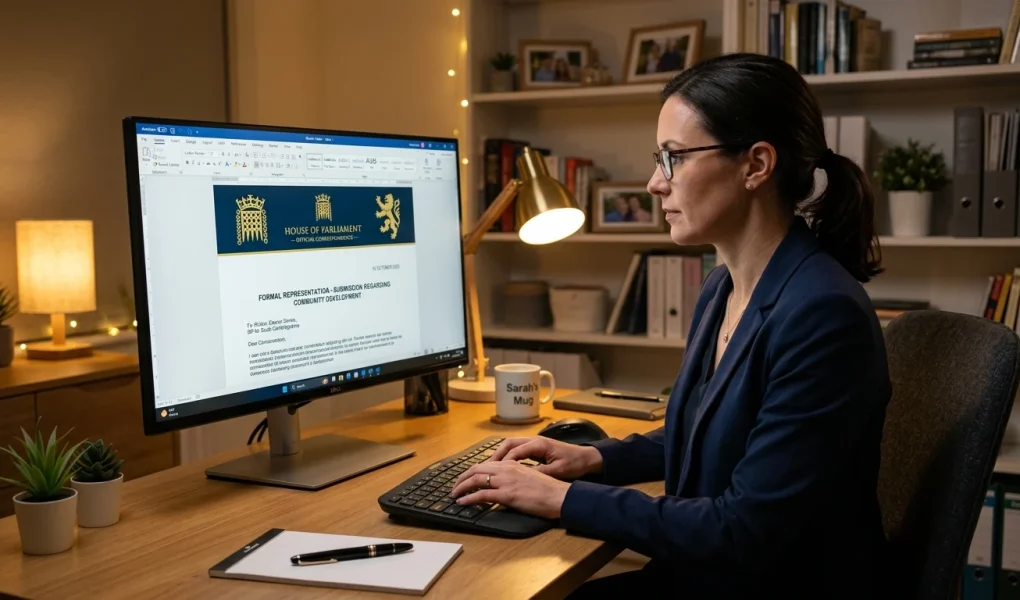
Electronic correspondence is the primary channel through which constituents communicate with their elected Members of Parliament (MPs). While emails are faster and more direct than postal mail, legislative offices receive hundreds of digital inquiries daily. Applying the proper parliamentary email etiquette, diplomatic salutations, and triage metadata ensures your message is prioritized rather than filtered as generic automated spam.
Table of Contents
- Constituency Inbox Filtering: How Parliamentary Email Triage Works
- Standard Salutations and Addressing Formats for MPs
- Step-by-Step Methodology for Drafting an Effective Email to Your MP
- Sample Professional Email Template to a Member of Parliament
- Common Mistakes to Avoid When Emailing Your MP
- Frequently Asked Questions on Emailing Members of Parliament
Constituency Inbox Filtering: How Parliamentary Email Triage Works
Every Member of Parliament maintains two distinct operational email setups: their parliamentary legislative inbox in Ottawa (or Westminster) and their local constituency office inbox. Correspondence directors and legislative aides scan incoming emails using automated filtering rules and triage protocols.
Emails that lack a clear physical address or postal code in the opening lines are frequently routed to low-priority review queues. Conversely, constituent communications that provide precise geographic identifiers, clear subject lines, and structured policy propositions are immediately cataloged for the MP’s weekly briefing docket.
For related guides on parliamentary communication, see our guide to addressing an MP in a formal letter and learn about what an MP can do for you.
Standard Salutations and Addressing Formats for MPs
The table below summarizes standard address protocols across different types of parliamentary representatives in email correspondence.
| Representative Role | Subject Line Format | Formal Email Salutation | Valediction / Sign-off |
|---|---|---|---|
| Backbench MP | Constituent Policy: [Issue] — [Name], [Postal Code] | Dear Mr./Ms. [Last Name], | Yours sincerely, |
| Cabinet Minister | Ministerial Inquiry: [Bill Name] — [Name], [Postal Code] | Dear Minister, / Dear Minister [Last Name], | Respectfully yours, |
| Prime Minister | Constituent Petition: [Topic] — [Name], [Postal Code] | Dear Prime Minister, / Dear Mr. Prime Minister, | I have the honour to be, Yours sincerely, |
| Opposition Leader / Privy Councillor | Policy Submission: [Topic] — [Name], [Postal Code] | Dear Mr./Ms. [Last Name], / Dear [First Name], | Yours sincerely, |
Step-by-Step Methodology for Drafting an Effective Email to Your MP
1. Writing an Optimized Subject Line
Your subject line must clearly indicate constituent status and legislative focus. Avoid vague titles such as “Urgent Question” or “Please Read”. Instead, employ the proven high-open formula:
[Constituent Standing] [Specific Bill / Policy Topic] — [Your Name], [Postal Code]
Example: Constituent Feedback on Bill C-18 (Online News Act) — Jane Doe, K1P 5J2
2. Opening with Geographical and Voter Verification
Open the body of the email with your constituent credentials. Parliamentary aides must confirm that you reside in the MP’s electoral district before initiating casework or policy logging. State your residential address in the first two sentences.
3. Presenting the Core Argument in 3 Structured Bullet Points
Legislative staff digest large volumes of digital correspondence daily. Format your core concerns into three clear, scannable bullet points detailing:
- The Issue: Specific statutory clause, municipal concern, or regulatory challenge.
- The Impact: Concrete local evidence, financial burden, or community Ramifications.
- The Requested Action: Explicit request for a committee vote, speaking point, or letter to the Minister.
4. Requesting a Written Response
Conclude with an explicit request for a formal written reply from the MP outlining their voting intentions or policy stance on the matter. Include your full contact information, including physical mailing address and telephone number, in your email signature block.
Sample Professional Email Template to a Member of Parliament
Subject: Constituent Perspective on Bill C-45 (Clean Energy Infrastructure) — [Your Name], [Postal Code]
Dear [Mr./Ms./Minister] [MP’s Last Name],
I am writing to you as a constituent residing at [Your Full Street Address, Postal Code] in [Riding / Constituency Name] to express my views regarding [Specific Bill Name and Number], which is currently before the House for second reading.
As our representative in Parliament, I urge you to support amendments that will protect local community infrastructure. In particular, I would like to highlight three critical considerations:
- Economic Impact: Small businesses across our riding will benefit significantly from the proposed clean technology investment tax credits outlined in Section 12.
- Environmental Safeguards: Mandating municipal consultation prior to federal project approvals will ensure that local ecological wetlands remain protected.
- Implementation Timelines: Providing a 24-month phased transition period will prevent unnecessary operational disruptions for local utility providers.
Could you please inform me of your intended vote on this legislation, as well as any interventions you plan to make during the Standing Committee hearings? I look forward to receiving your written response on this matter.
Thank you for your dedicated service to our community.
Yours sincerely,
[Your Full Name]
[Your Full Street Address]
[City, Province, Postal Code]
[Telephone Number | Email Address]
Common Mistakes to Avoid When Emailing Your MP
- Omitting Your Postal Code: Sending an email without a physical address guarantees it will be treated as non-constituent mail with the lowest triage priority.
- Using Mass Form Email Templates: Automated campaign emails generated by petition websites are aggregated into bulk summary counts. Personalized emails written in your own words receive individual staff review.
- Combining Multiple Unrelated Topics: Keep your email focused on a single legislative issue or bill. Multiple disparate topics complicate staff routing and delay response times.
- Using Inappropriate or Inflammatory Language: Abusive or disrespectful correspondence is automatically archived without reply under parliamentary workplace safety protocols.
Frequently Asked Questions on Emailing Members of Parliament
Do MPs read all incoming emails personally?
In most parliamentary offices, incoming emails are first triaged and cataloged by legislative assistants and correspondence directors. The MP reviews comprehensive weekly summaries, key casework escalations, and representative constituent letters prior to parliamentary debates.
What email address should you use to contact your MP?
Members of the Canadian House of Commons use the standard email format firstname.lastname@parl.gc.ca. You can find your MP’s official parliamentary and constituency email addresses on the official Parliament of Canada website (ourcommons.ca).
How long does it take for an MP to respond to an email?
Constituents typically receive an automated receipt immediately, followed by a substantive response from the MP or a senior legislative aide within two to four weeks, depending on whether Parliament is currently in session.
Can you email an MP if you are not in their constituency?
Under parliamentary convention, MPs primarily represent their own constituents. If you email an MP from another riding on a local issue, their office will typically redirect your correspondence to your own local MP. However, if the MP is a Cabinet Minister, they accept policy correspondence nationally within their ministerial portfolio.
Get our latest guides, news, and insights highlighted in your Google Search & AI Overviews.


