✨ This article was AI edited. Editorial responsibility: DemocracyLawBlog.com.
Produced with AI. This article was artificially generated. Editorial responsibility: DemocracyLawBlog.com.
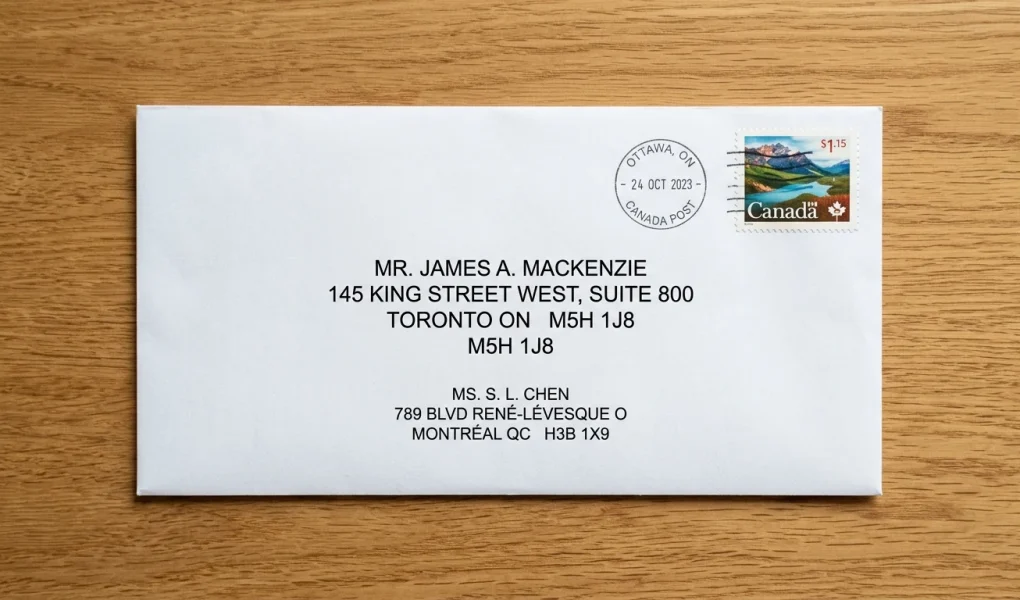
A Canadian mailing address must be formatted in uppercase block letters with a maximum of three to five lines: recipient name, optional organization, street address with unit number, followed by the municipality, two-letter province abbreviation, and six-character alphanumeric postal code (e.g., OTTAWA ON K1A 0A6) separated by two spaces.
Accurate address formatting is essential for ensuring that legal filings, parliamentary petitions, voter registration documents, and official civic correspondence reach government ministries and legislative offices without processing delays. Canada Post enforces automated optical character recognition (OCR) sorting standards that require strict adherence to spatial conventions and character formatting.
Table of Contents
- Official Canada Post Address Formatting Architecture
- Standard Address Elements and Line-by-Line Specifications
- Detailed Rules for Canadian Postal Standards
- Special Protocol: Mailing to Canadian Members of Parliament (Postage-Free)
- Addressing Civic Submissions and Ministry Petitions
- Optical Character Recognition (OCR) Envelope Guidelines
- Common Address Formatting Errors to Avoid
- Frequently Asked Questions on Canadian Address Formatting
Official Canada Post Address Formatting Architecture
Canada Post guidelines require all addresses to follow a structured hierarchy designed for automated high-speed sorting. Adhering to these specifications prevents manual sorting reroutes and eliminates delivery delays for critical legal and political correspondence.
For related guides on parliamentary mail, see our guide on writing out Canadian mailing addresses correctly and learn about addressing envelopes in Canada.
Standard Address Elements and Line-by-Line Specifications
| Line Position | Content Description | Standard Canada Post Example |
|---|---|---|
| Line 1 (Top) | Recipient Name & Formal Title | THE RIGHT HONOURABLE JUSTIN TRUDEAU |
| Line 2 (Optional) | Department, Ministry, or Business Name | OFFICE OF THE PRIME MINISTER |
| Line 3 | Civic Address (Unit, Street Number, Street Name, Type) | 80 WELLINGTON ST ROOM 300 |
| Line 4 (Bottom) | Municipality, Province Code, Postal Code | OTTAWA ON K1A 0A2 |
Detailed Rules for Canadian Postal Standards
1. Postal Code Format & Spatial Separation
The Canadian postal code is a six-character alphanumeric code in the format A1A 1A1 (Letter-Number-Letter Number-Letter-Number). The two sections—the Forward Sortation Area (FSA) and the Local Delivery Unit (LDU)—must be separated by a single space. When placed on the bottom line alongside the city and province, separate the province abbreviation and the postal code with two blank spaces.
2. Standard Two-Letter Canadian Province & Territory Abbreviations
Never spell out the full province name on the bottom line. Always utilize the official two-letter standard codes approved by Canada Post:
- Alberta:
AB - British Columbia:
BC - Manitoba:
MB - New Brunswick:
NB - Newfoundland and Labrador:
NL - Northwest Territories:
NT - Nova Scotia:
NS - Nunavut:
NU - Ontario:
ON - Prince Edward Island:
PE - Quebec:
QC - Saskatchewan:
SK - Yukon:
YT
3. Civic Street Types and Directional Abbreviations
To ensure machine readability, use standardized street abbreviations without punctuation:
- Street / Avenue / Boulevard / Road:
ST,AVE,BLVD,RD,DR,CRES,WAY,CRT - Directionals (North, South, East, West):
N,S,E,W,NE,NW,SE,SW - Unit Designators: Place the unit or apartment number before the street number with a hyphen (e.g.,
104-250 ALBERT ST) or useSUITE 300orAPT 12on the same line.
Special Protocol: Mailing to Canadian Members of Parliament (Postage-Free)
Under Section 35 of the Canada Post Corporation Act, Canadian citizens may send mail to the Governor General, the Speaker of the Senate, the Speaker of the House of Commons, and any sitting Member of Parliament in Ottawa completely postage-free. The address must be formatted as follows:
[Name of Member of Parliament], M.P.
House of Commons
Ottawa ON K1A 0A6
(No postage stamp required)
This statutory privilege applies to all letters weighing up to 50 grams addressed to parliamentary offices in the parliamentary precinct in Ottawa. Note that mail sent to local constituency offices outside of Ottawa still requires standard domestic postage stamps.
Addressing Civic Submissions and Ministry Petitions
When sending official regulatory filings, administrative petitions, or legal submissions to federal or provincial ministries, adhere to the following addressing conventions:
| Recipient Category | Line 1 & 2 | Line 3 & 4 |
|---|---|---|
| Prime Minister of Canada | THE RIGHT HONOURABLE [NAME], P.C., M.P. OFFICE OF THE PRIME MINISTER | 80 WELLINGTON ST OTTAWA ON K1A 0A2 |
| Federal Cabinet Minister | THE HONOURABLE [NAME], P.C., M.P. MINISTER OF [PORTFOLIO] | HOUSE OF COMMONS OTTAWA ON K1A 0A6 |
| Provincial Premier (e.g. Ontario) | THE HONOURABLE [NAME], M.P.P. PREMIER OF ONTARIO | LEGISLATIVE BUILDING, QUEEN’S PARK TORONTO ON M7A 1A1 |
| Provincial MLA (e.g. Alberta) | [NAME], M.L.A. LEGISLATIVE ASSEMBLY OF ALBERTA | 10800 97 AVE NW EDMONTON AB T5K 2B6 |
Optical Character Recognition (OCR) Envelope Guidelines
To maximize speed through Canada Post automated mail processing plants, observe these physical layout dimensions:
- Address Zone Placement: Position the delivery address block within the central zone of the envelope, maintaining at least 15 mm clearance from the bottom edge and 15 mm from both sides.
- Return Address: Place the return address in the upper left corner, using font size smaller than the delivery address.
- Typography: Use clean sans-serif fonts such as Arial, Helvetica, or Univers between 10 pt and 12 pt. Avoid script, italicized, or highly stylized typefaces.
- No Underlining or Graphics: Do not underline words or place logos within the address block area.
Common Address Formatting Errors to Avoid
- Using Commas and Periods: Punctuation marks confuse automated optical character readers. Write
OTTAWA ON K1A 0B1rather thanOttawa, Ont., K1A-0B1. - Incorrect Postal Code Spacing: Always maintain exactly one space in the middle of the postal code (
K1A 0A6) and two spaces between the province code and the postal code. - Misplacing Unit Numbers: Place unit numbers on the same line as the street address, either before the street number with a hyphen (
402-150 METCALFE ST) or after the street name (150 METCALFE ST SUITE 402). - Spelling Out Province Names: Always use the two-letter standard code (e.g.,
BCinstead ofBritish Columbia).
Frequently Asked Questions on Canadian Address Formatting
Should punctuation (periods or commas) be used in Canadian addresses?
No. Canada Post strongly recommends omitting all punctuation—such as periods after abbreviations or commas between city and province—to facilitate optical character recognition (OCR) scanner reading.
Can addresses be written in lowercase letters?
While mixed-case letters will generally be delivered, Canada Post standardizes on all uppercase (capital) letters for optimal automated sorting efficiency.
Is mail to Canadian Members of Parliament free of postage?
Yes. Under the Canada Post Corporation Act, mail sent to sitting Members of Parliament at their House of Commons address in Ottawa is postage-free up to 50 grams.
What is the difference between an FSA and an LDU in a postal code?
The Forward Sortation Area (FSA) consists of the first three characters (e.g., K1A) representing a major geographical district. The Local Delivery Unit (LDU) consists of the final three characters (e.g., 0A6) identifying a specific street block, office building, or rural route.
Get our latest guides, news, and insights highlighted in your Google Search & AI Overviews.