✨ This article was AI edited. Editorial responsibility: DemocracyLawBlog.com.
Produced with AI. This article was artificially generated. Editorial responsibility: DemocracyLawBlog.com.
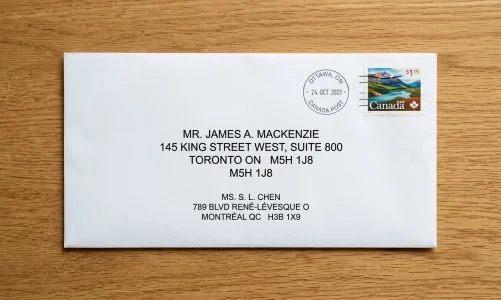
The correct Canadian mailing address format follows Canada Post’s automated optical scanning standards: write in uppercase block letters with no punctuation, placing the recipient on Line 1, civic address on Line 2, and the city, two-letter province code, and alphanumeric postal code (e.g., TORONTO ON M5H 2N2) with two spaces on the bottom line.
Whether submitting legal pleadings, sending corporate correspondence, or mailing petitions to parliamentary committees, ensuring your Canadian mailing address conforms to official Canada Post specifications prevents costly automated sorting delays and delivery reroutes. This comprehensive guide outlines the exact technical standards required for both domestic and international mail sent to Canadian destinations.
Table of Contents
- Canada Post Optical Character Recognition (OCR) Standards
- Structural Line-by-Line Addressing Hierarchy
- Essential Rules for Canadian Postal Formats
- Special Addressing Protocols for Government and Legal Entities
- Envelope Physical Layout Dimensions
- Common Addressing Mistakes to Avoid
- Frequently Asked Questions Regarding Canadian Address Formatting
Canada Post Optical Character Recognition (OCR) Standards
Modern postal facilities process millions of mailpieces daily using high-speed optical character recognition (OCR) and automated barcode sprayers. When an envelope fails automated machine reading due to improper punctuation, incorrect font choice, or misaligned spacing, it is diverted to manual sorting, adding 48 to 72 hours to delivery transit times.
For related guides on civic and political mail, review our guide to writing addresses on letters in Canada and discover how to use postal codes to locate representatives.
Structural Line-by-Line Addressing Hierarchy
| Line Position | Standard Element | Correct Format Example | Formatting Rule |
|---|---|---|---|
| Line 1 | Recipient Name | DR ELEANOR VANCE | Uppercase, no honorific periods |
| Line 2 (Optional) | Company / Ministry / Division | DEPARTMENT OF JUSTICE CANADA | Official legal business name |
| Line 3 | Delivery Address (Unit & Street) | 284 WELLINGTON ST SUITE 400 | Unit designator with street |
| Line 4 (Bottom) | Municipality, Province, Postal Code | OTTAWA ON K1A 0H8 | 2-letter province, 2 spaces before postal code |
Essential Rules for Canadian Postal Formats
1. Standard Province and Territory Two-Letter Abbreviations
Canada Post mandates the use of official two-letter standard symbols. Full province names should never be written on the destination line:
- AB — Alberta
- BC — British Columbia
- MB — Manitoba
- NB — New Brunswick
- NL — Newfoundland and Labrador
- NT — Northwest Territories
- NS — Nova Scotia
- NU — Nunavut
- ON — Ontario
- PE — Prince Edward Island
- QC — Quebec
- SK — Saskatchewan
- YT — Yukon
2. Postal Code Architecture: FSA and LDU
The Canadian postal code is a six-character alphanumeric string formatted as A1A 1A1 (Letter-Number-Letter [space] Number-Letter-Number):
- Forward Sortation Area (FSA): The first three characters represent a geographic sorting district (e.g.,
K1Afor parliamentary Ottawa). - Local Delivery Unit (LDU): The final three characters designate a specific street segment, large commercial building, or delivery route (e.g.,
0H8). - Spacing Rule: Maintain exactly one blank space between the FSA and LDU, and two blank spaces between the province abbreviation and the postal code.
3. Unit, Suite, and Apartment Number Formatting
There are two acceptable methods for placing unit designators on Canadian envelopes:
- Prefixed with Hyphen: Place the unit number before the street number followed by a hyphen (e.g.,
12-450 QUEEN ST W). - Suffixed on Same Line: Place the unit descriptor after the street name (e.g.,
450 QUEEN ST W SUITE 12orAPT 3B).
Special Addressing Protocols for Government and Legal Entities
When sending correspondence to the federal government or parliamentary bodies in Ottawa, observe standard statutory protocols:
OFFICE OF THE PRIME MINISTER
80 WELLINGTON ST
OTTAWA ON K1A 0A2
CANADA
SUPREME COURT OF CANADA
301 WELLINGTON ST
OTTAWA ON K1A 0J1
CANADA
Envelope Physical Layout Dimensions
To ensure automated sorting clearance across Canada Post machinery, follow these spatial parameters:
- Address Zone: Center the address block horizontally and vertically on the envelope, leaving at least 15 mm margins from the bottom edge and sides.
- Return Address: Place in the top-left corner, ensuring text is smaller than the destination block.
- Postage Zone: Top-right corner (measuring 40 mm x 40 mm).
- Barcode Read Area: Keep the bottom 19 mm of the envelope completely free of all text, logos, or handwritten notes.
Common Addressing Mistakes to Avoid
- Including Punctuation: Avoid commas, periods, or apostrophes (write
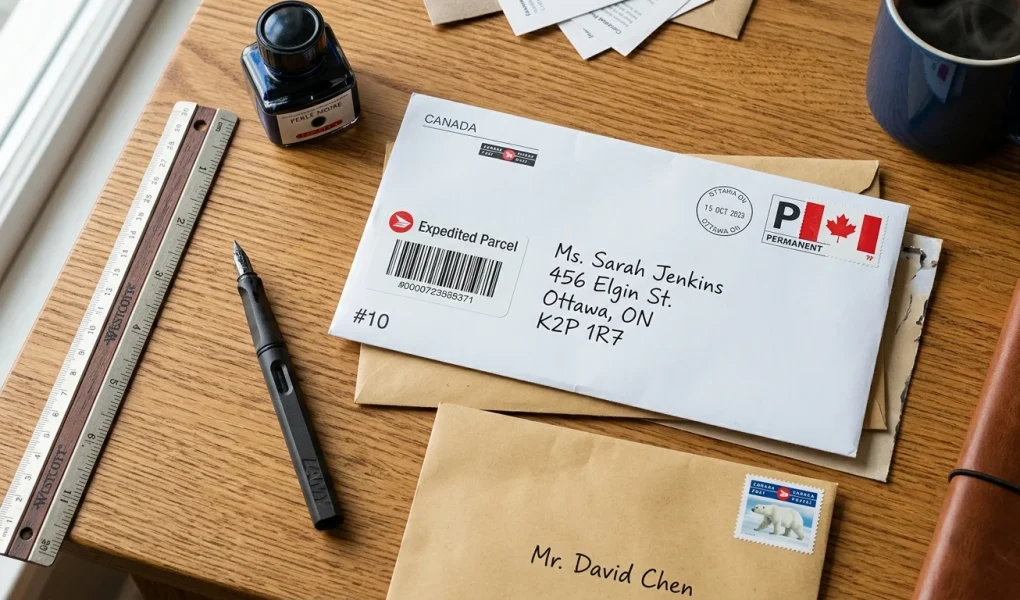
STinstead ofSt.andOTTAWA ONinstead ofOttawa, ON,). - Using Lowercase or Italic Fonts: Lowercase and stylized script typefaces increase optical scanner error rates. Use standard block capitals.
- Writing Canada on Domestic Mail: The country name
CANADAis only required on international mail originating outside Canadian borders. - Double Lines for Postal Codes: Never place the postal code on a separate standalone line below the city and province; it must appear on the same bottom line.
Frequently Asked Questions Regarding Canadian Address Formatting
How many spaces should be between the province code and postal code?
Canada Post guidelines specify exactly two blank spaces between the two-letter province abbreviation and the six-character postal code (e.g., CALGARY AB T2P 1J9).
Can you write Canadian addresses in French?
Yes. Canada Post fully supports both English and French addressing standards. In French formatting, street types precede the name without punctuation (e.g., 150 RUE SAINTE-CATHERINE O), and province abbreviations remain identical.
Is punctuation completely forbidden on Canadian mail?
While mail with punctuation will still be delivered, Canada Post strongly advises against periods, commas, and dashes (except within postal codes or hyphens between unit and street numbers) to optimize automated OCR scanner throughput.
What happens if a Canadian postal code has no space in the middle?
Postal codes written without a space (e.g., K1A0A6) may fail automated sorting passes, resulting in manual processing delays. Always maintain a single space between the first three and last three characters.
Get our latest guides, news, and insights highlighted in your Google Search & AI Overviews.